Product Quizzes for Skincare Brands: A Shopify Playbook
Think about the last time you bought skincare online without knowing the brand. You probably opened five product pages in different tabs, read half the ingredient lists, googled “is niacinamide bad with vitamin C,” and either bought nothing or ended up with whatever had the most reviews, hoping for the best.
That’s a trust problem, not a browsing problem and it’s exactly why skincare brands, more than almost any other category, have so much to gain from a good skincare quiz.
Why skincare shoppers behave this way
Most online stores deal with plain old choice overload: too many products, not enough time. Skincare has that same problem with a second one stacked on top, shoppers often don’t have a solid idea of what they actually need. They think they have “sensitive skin” when what they really have is dehydrated skin. They think their breakouts mean oily skin when what’s actually going on is a barrier function issue made worse by over-cleansing. Ask any esthetician — helping a client correctly identify their own skin concern is half the job.
Skincare isn’t a single purchase decision either; it’s a routine. A cleanser can’t do much without the right moisturizer backing it up, and a serum picked in isolation can undo whatever the rest of the routine was accomplishing. When most stores present products one at a time, it’s assumed the shopper can somehow build a coherent stack on their own from a grid of thumbnails. That’s a lot to ask of someone who came in not even sure whether they have “combination” skin or just “kind of unpredictable” skin.
This is precisely why a product recommendation quiz works so well in this category. It doesn’t just recommend products, it replaces a guessing game with something that feels closer to a real skin consultation. Answer a few honest questions, get matched with what’s actually right for your skin. That’s something scrolling and hoping simply can’t replicate.
What a good skincare quiz should actually ask
A lot of brands miss the mark by building a quiz for skincare that feels more like a customer satisfaction survey than a diagnostic tool. If a shopper can’t tell why you’re asking a question, they’ll bail midway through and rightfully so. Nobody wants to answer ten questions just to land on a product they could’ve found in the “bestsellers” section anyway.
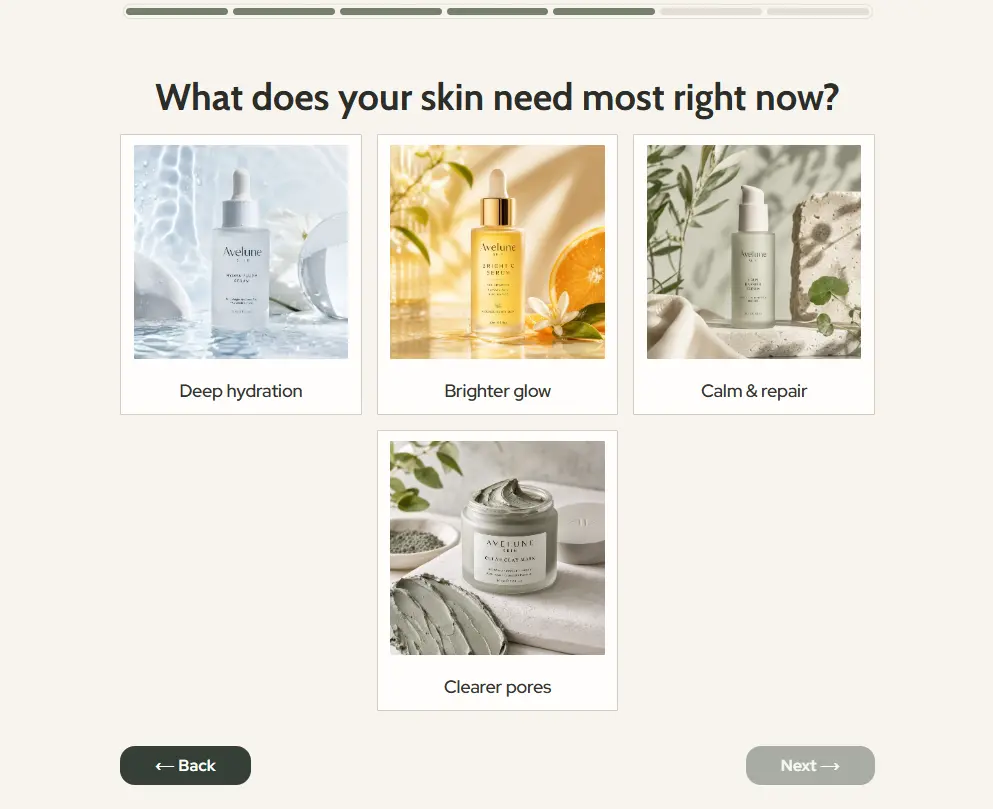
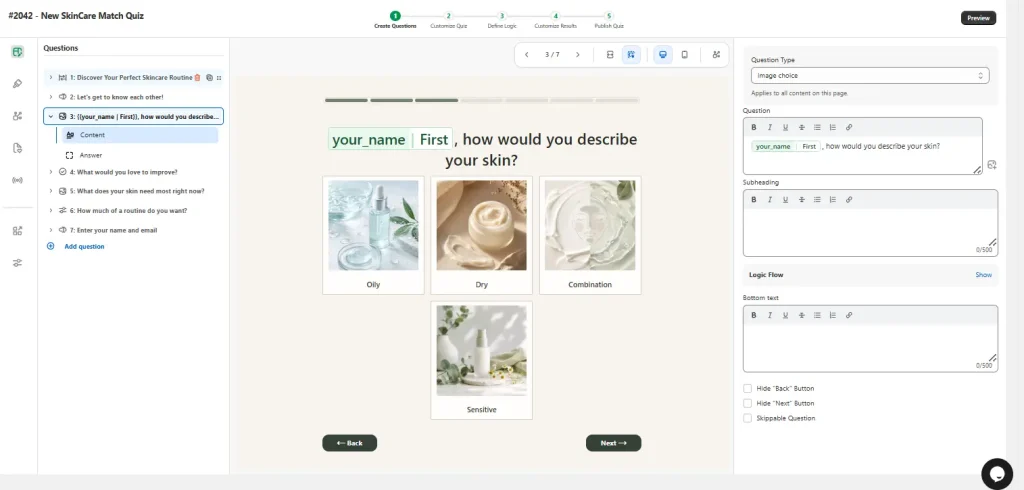
A skin quiz that actually earns its keep typically starts with skin type (oily, dry, combination, normal), then narrows to the one or two concerns that matter most to that person right now, rather than asking them to check every box that could vaguely apply. Next comes the question people often forget but can’t afford to skip: sensitivities and reactions. If someone’s had a bad experience with fragrance or a specific active ingredient before, that needs to be ruled out early not treated as a secondary detail. From there, it’s worth asking what’s already in their routine, since that’s what allows the quiz to recommend a full stack instead of one more random bottle. A couple of softer questions on climate or sun exposure round things out and make the final personalized skincare recommendation feel like it was actually built for that specific person.
Six to nine well-chosen questions will almost always outperform fifteen exhaustive ones. The goal of a good product quiz isn’t to interrogate the shopper about their skin — it’s to ask just enough to get the recommendation right.
Turning quiz answers into a recommendation that feels earned
The questions are only half of it. What you do with the answers is where a skin care quiz either earns its keep or falls flat.
The single biggest lever is recommending a full routine rather than a stand-alone product. A cleanser, serum and moisturizer bundle labeled “your personalized routine” does far more for average order value than any single-item match, and it’s also more honest, most skin concerns aren’t solved by one product.
The second lever is showing your work. “Because you told us you have combination skin with occasional breakouts, we matched you with a lightweight, non-comedogenic formula” does something a bare product card never will: it makes the shopper feel diagnosed by a smart skincare recommendation quiz, not just upsold by another popup.
Sensitivities should always be weighed before concerns in the quiz logic. If someone flags a fragrance sensitivity and still ends up looking at a fragranced product at the end, you haven’t just lost a sale, you’ve told them the quiz wasn’t actually listening.
The data doesn’t stop mattering after checkout
There’s a part of this most brands miss entirely: everything a shopper tells your skincare product quiz is worth more than almost anything you could infer from browsing behavior. It’s a real skin profile, volunteered directly by the shopper instead of guessed at from click data and that makes it some of the highest-quality zero-party data a beauty brand can collect.
Use it. Someone who flagged acne-prone, sensitive skin shouldn’t land in the same follow-up email sequence as someone who came in worried about fine lines different concerns mean different content and different products worth surfacing later. Skincare also runs on a fairly predictable usage cycle, so knowing exactly which product someone was matched to lets you send a replenishment email right around when they’re likely running low, instead of guessing. And if their quiz results pointed to a routine gap they didn’t purchase the first time, that’s a natural, low-pressure thing to bring up in a follow-up not a generic “you might also like” nudge.
Zoomed all the way out, the aggregate answers from everyone who’s taken your quiz tell you something too: which concerns come up most, which sensitivities repeat, where your catalog might have a gap worth filling.
A few ways skincare quizzes go wrong
The most common mistake is asking too much. Brands sometimes try to recreate an entire in-person consultation inside a skincare quiz app, and shoppers drop off long before reaching a result. Another is delivering a recommendation with no explanation attached, just a product card — which quietly undercuts the whole point of feeling diagnosed rather than marketed to. The mistake that does the most damage, though, is ignoring a flagged sensitivity in the final match. That’s the moment a shopper stops trusting the quiz and often the brand along with it. Even once all of that’s fixed, it’s worth remembering the quiz shouldn’t just disappear after the sale. Treated as a one-time conversion tool, it wastes almost everything useful it collected.
Building a skincare quiz with an AI Quiz Maker
Everything above is buildable directly in QuizShop, an AI Quiz Maker built for Shopify stores: branching logic that treats sensitivities as a filter before concerns are even weighed, result pages that recommend a full routine instead of a single product, a template that shows the reasoning behind every match, and quiz answers that tag directly onto the customer profile so they can drive your Klaviyo or Shopify email flows afterward. Because the questions feel diagnostic rather than promotional, this kind of skincare quiz tends to see meaningfully higher completion rates than the ecommerce average and gives your brand a product recommendation quiz shoppers actually want to finish.
Building a skincare quiz for your Shopify store? QuizShop is the AI Quiz Maker that lets you set up branching skin-type and concern logic, routine-based recommendations, and post-quiz customer tagging without writing any code.